
The IC-38 (Life) paper asks 50 questions and you need 18 of them right. That is the whole bar, and it is lower than most candidates assume. What catches people out is not the paper — it is the twelve-month expiry on the pass certificate and the 25 hours of training that have to happen before you sit at all. This post works through the current IRDAI position on both, and then through the 21 chapters the Life branch syllabus actually contains.
What IC-38 is, and the numbers that define it
IC-38 is the pre-recruitment examination that an individual has to clear before an insurer can appoint them as an insurance agent. Under Regulation 6(1) of the IRDAI (Appointment of Insurance Agents) Regulations, 2016, an applicant "shall pass in the Insurance Agency Examination conducted by the Examination Body in the subjects of Life, General, Health Insurance as the case may be, as per the syllabus prescribed by the Authority". The Insurance Institute of India is that examination body, and IC-38 is the study material and paper it publishes, in separate Life, Non-Life and Health versions.
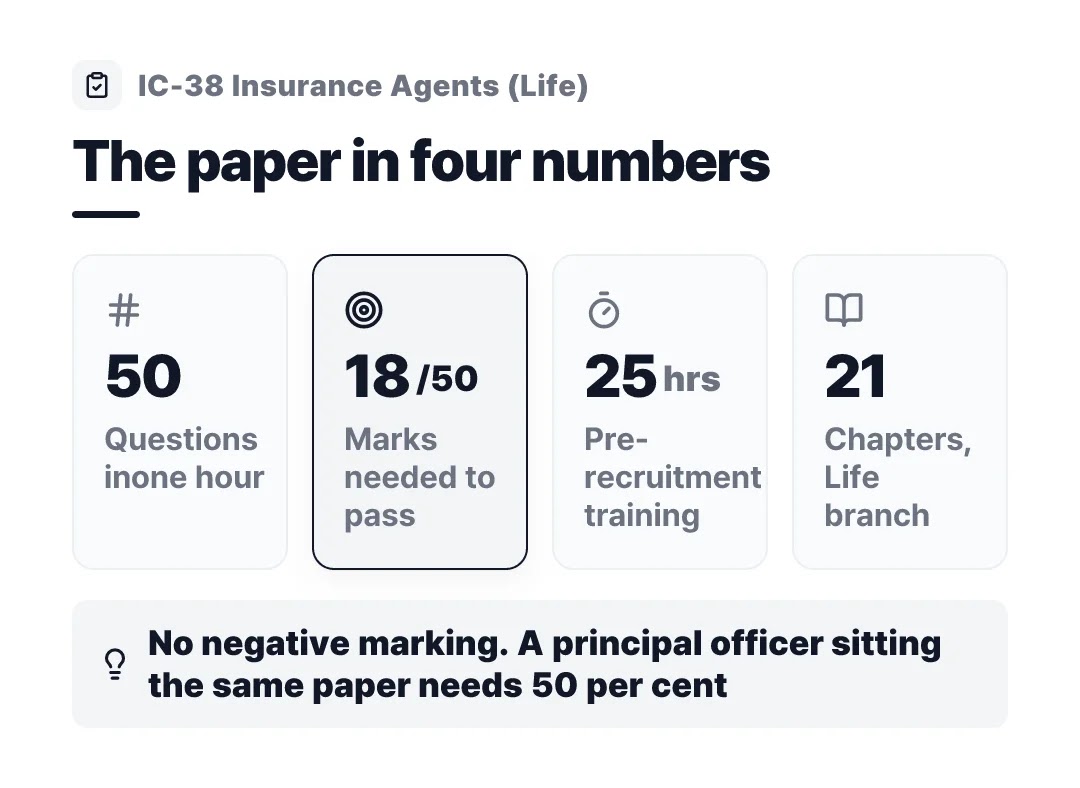
The paper is computer-based: 50 multiple-choice questions in one hour, with no negative marking. The pass mark for an agent is 35 per cent, which works out to 18 marks. That same 35 per cent applies to specified persons and authorised verifiers of a corporate agent; a principal officer sitting the same IC-38 paper needs 50 per cent. The figures come from the annexure to IRDAI circular IRDA/INT/CIR/T&E/136/07/2016, which harmonised training and examination requirements with effect from 1 October 2016.
One point of separation before going further. IC-38 is the route to a full agency appointment. The Point of Sales Person route is a different and lighter channel, with its own training requirement and its own examination, and it does not run on IC-38. If you are weighing the two, they are not versions of the same qualification.
The 21 chapters — five common, eleven life, five health
The Insurance Institute of India publishes the syllabus for IC38 Insurance Agents (Life Branch) as three sections containing 21 chapters in total. Section I holds five common chapters that appear in every branch of IC-38. Section 2 holds the eleven life-specific chapters. Section 3 holds five chapters on health insurance, which is the part most candidates do not expect to find in a paper labelled Life.

| Section | Chapters | Count | Share of the syllabus |
|---|---|---|---|
| I — Common | 1 to 5 | 5 | 24% |
| 2 — Life | 6 to 16 | 11 | 52% |
| 3 — Health | 17 to 21 | 5 | 24% |
| Total | 1 to 21 | 21 | 100% |
The chapter numbers and section boundaries are taken from the official III syllabus document for the Life branch; the counts and shares are worked out from it. Section 3 is worth pausing on. Chapters 17 to 21 run from an introduction to health insurance through documentation, products, underwriting and claims — a complete small syllabus of its own, sitting inside the Life paper. Candidates who prepare only the life chapters walk in having skipped roughly a quarter of the ground.
Ten chapters that come in pairs
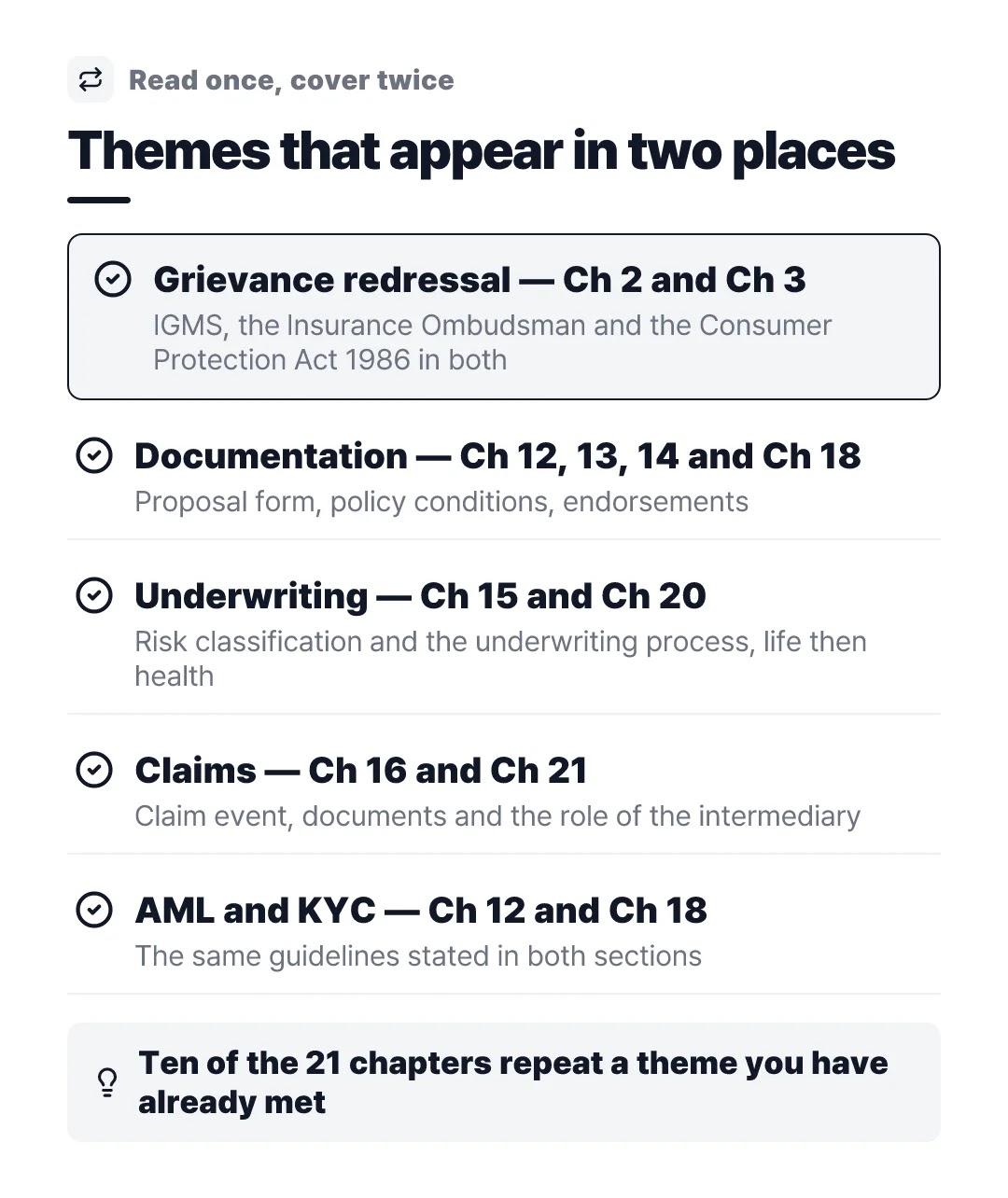
Read the syllabus closely and a pattern shows up that changes how long preparation takes. Several themes are covered twice, once in the life section and once in the health section, or twice within the common section. Learn the theme once and you have covered two chapters.
| Theme | Chapters | What repeats |
|---|---|---|
| Grievance redressal | 2 and 3 | IGMS, the Insurance Ombudsman, Consumer Protection Act 1986 |
| Documentation | 12, 13, 14 and 18 | Proposal form, policy conditions, endorsements |
| Underwriting | 15 and 20 | Risk classification, the underwriting process |
| Claims | 16 and 21 | Claim event, documents, the role of the intermediary |
| AML and KYC | 12 and 18 | The same guidelines, stated in both sections |
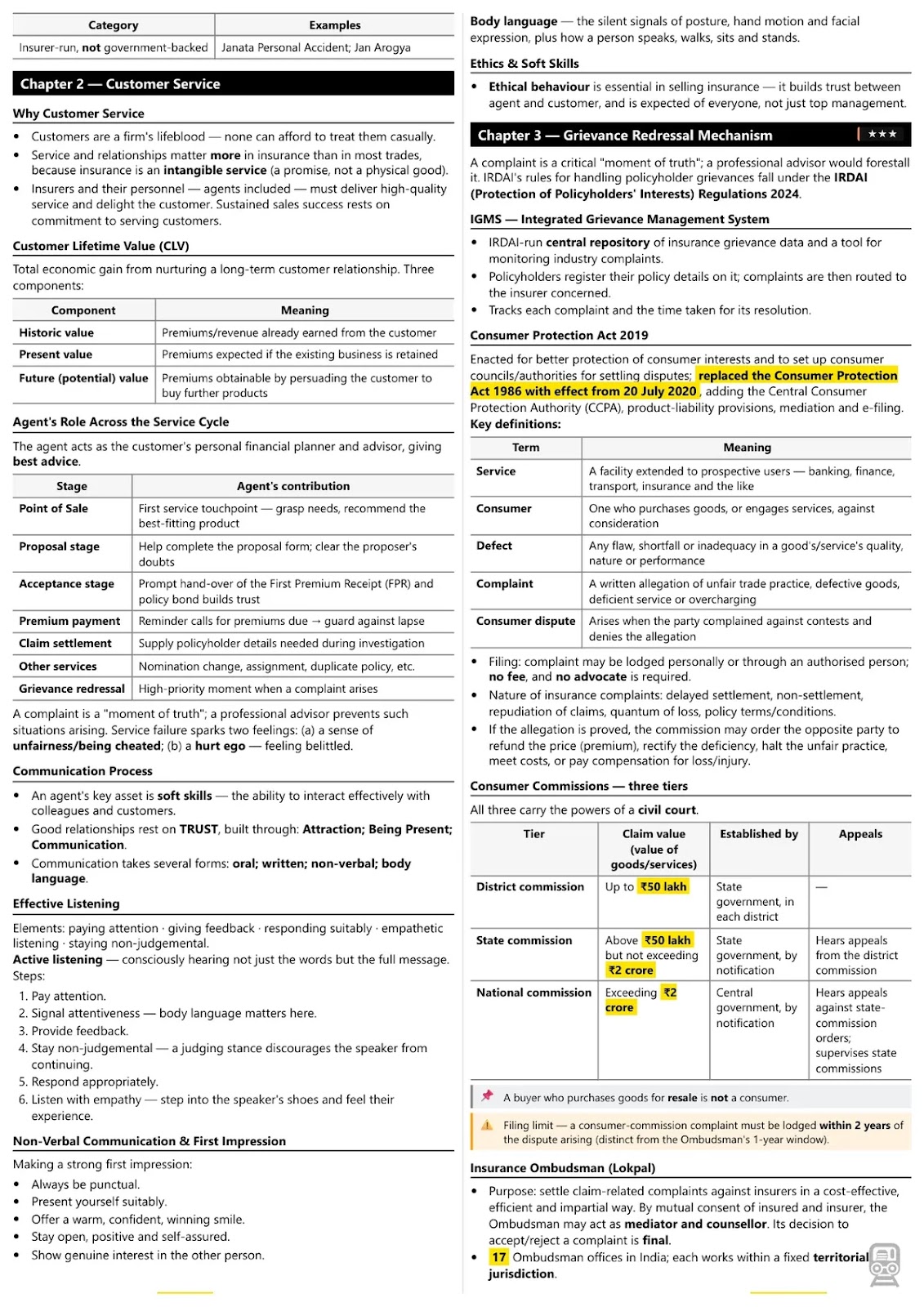
Chapters 2 and 3 are the clearest case. Chapter 2 is titled Customer Service, but its later half lists grievance redressal, the Integrated Grievance Management System, the Consumer Protection Act, 1986 and the Insurance Ombudsman. Chapter 3 is titled Grievance Redressal Mechanism and lists consumer courts, the Ombudsman, IGMS and the same Act. Preparing them as one block rather than two removes an evening from the schedule.
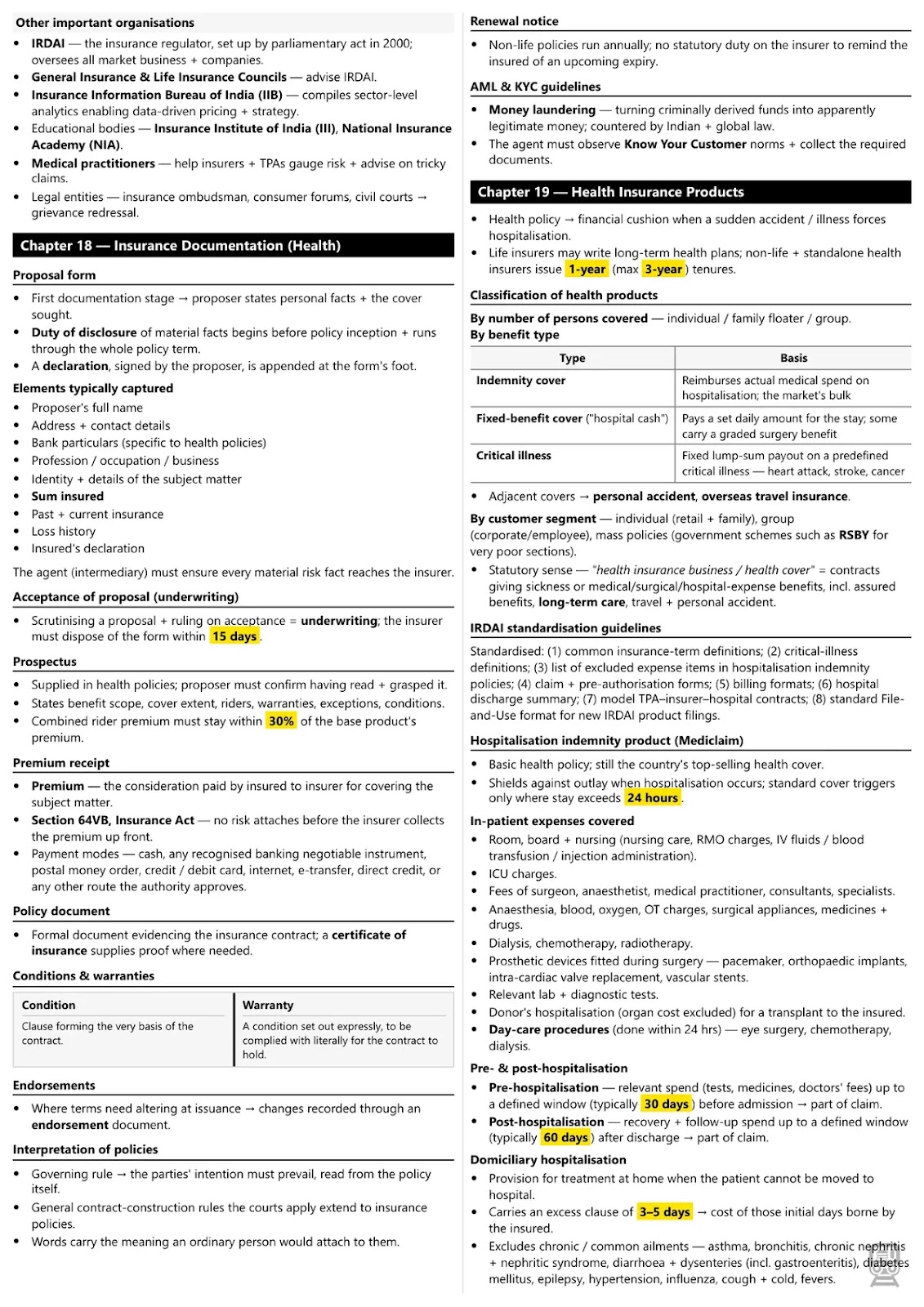
Underwriting is the pair worth the most attention. Chapter 15 covers life underwriting — equity among risks, risk classification, non-medical underwriting, the agent as primary underwriter. Chapter 20 covers health underwriting, including file-and-use guidelines and group health. The vocabulary carries across, so reading them back to back is faster than meeting the same terms a fortnight apart.
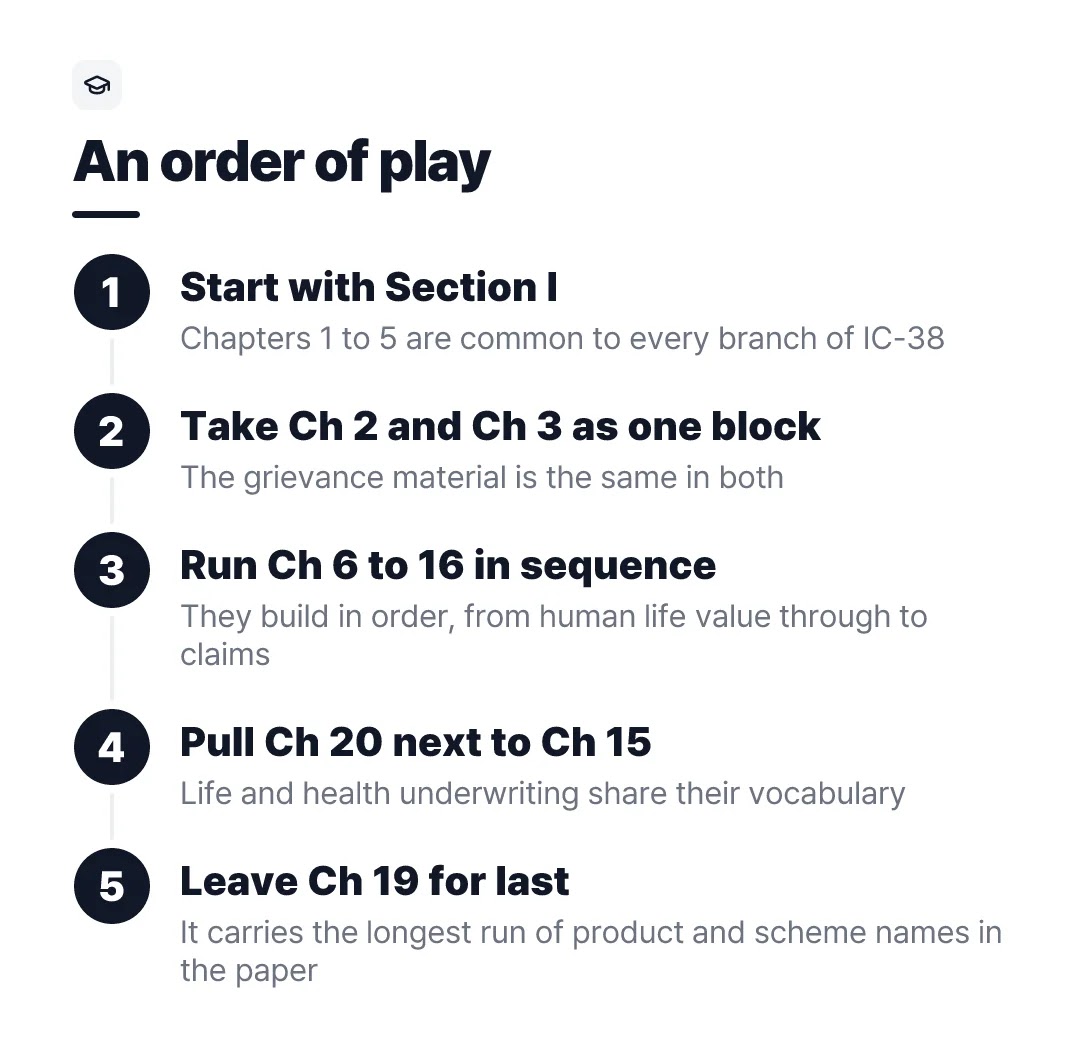
That gives a workable order. Start with Section I, taking Chapters 2 and 3 together. Then run Chapters 6 to 16 in sequence, because they are built in order, from human life value through products, documentation and pricing to claims. Pull Chapter 20 forward to sit next to Chapter 15, and leave Chapter 19 for last — it carries the longest run of product and scheme names in the paper, and that kind of list keeps better over a short gap.
The twelve-month certificate, and the 25 hours before it
Two rules decide when you should sit the paper rather than how you prepare for it. The first is training. The 2016 Regulations tell insurers to prescribe practical training in line with the syllabus set by the Authority "for not less than 25 hours", and the 2016 harmonisation circular puts agents at 25 hours of fresh training with no renewal training prescribed. The widely repeated figure of 50 hours belongs to the pre-2016 licensing regime and no longer describes what an individual agent has to complete.
The second rule is the one that costs people money. Regulation 6(2) states that the pass certificate issued by the examining body "shall be in force for a period of twelve months, for the purpose of seeking appointment as an agent with any insurer for the first time". Clear IC-38 and then let a year pass without an appointment, and the certificate lapses. If you are sitting the paper speculatively, before you have settled which insurer will appoint you, that twelve-month window is the real deadline in the process.
On eligibility, the regulations leave the specifics to the insurer's board-approved policy, which has to cover eligible age and eligible educational qualification. The suggested minimum qualification named in the regulations is a pass in the 10th standard or an equivalent examination from a recognised board or institution. Because the age and any interview step sit in the insurer's own policy rather than in a single national rule, confirm them with the insurer sponsoring you. As of September 2026 the 2016 regulations remain the operative framework for agent appointment, although IRDAI has consolidated several neighbouring regulations since 2024, so it is worth a check before you apply.
Inside the 19 pages
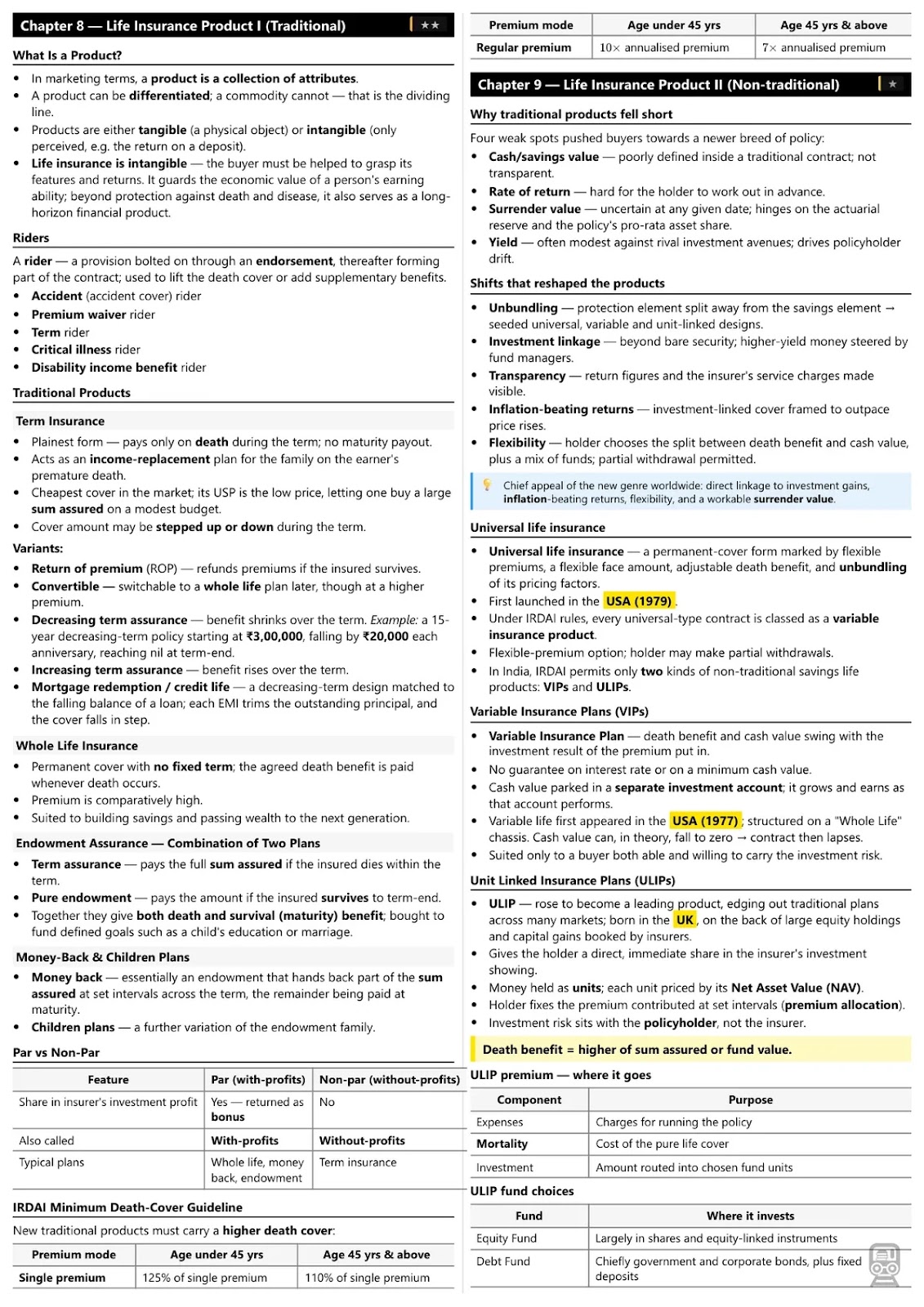
The IC-38 (Life) revision notes run to 19 pages. The syllabus was rearranged rather than summarised chapter by chapter: the paired themes above are merged so that grievance redressal, underwriting, claims and documentation each appear once with both the life and the health treatment side by side, and the common chapters sit first because they carry across branches. Underwriting and grievance redressal get the most space, which reflects how often their vocabulary recurs across the 21 chapters. These are revision notes at ₹ 299 — there are no question papers or mock tests inside, and the notes are meant to be read after the training, not instead of it.
👉 IC-38 Insurance Agents (Life) revision notes — PDF (19 pages)
https://www.rattanote.com/library/ic-38-life-revision-notes
FAQ
How many marks are needed to pass IC-38?
Eighteen out of 50. The pass mark for an insurance agent is 35 per cent, set in the annexure to the IRDAI harmonisation circular of 14 July 2016. There is no negative marking, so every question is worth attempting. A principal officer of a corporate agent, broker or insurance marketing firm sitting the same paper needs 50 per cent.
Is IC-38 training 25 hours or 50 hours?
Twenty-five hours. The IRDAI (Appointment of Insurance Agents) Regulations, 2016 direct insurers to prescribe practical training of not less than 25 hours in line with the Authority's syllabus, and the accompanying circular lists agents at 25 hours of fresh training with no renewal training. The 50-hour figure still circulating online predates the 2016 framework.
How long is the IC-38 pass certificate valid?
Twelve months. Regulation 6(2) limits the pass certificate to a period of twelve months for the purpose of seeking a first appointment as an agent with any insurer. Clearing the paper well before you have an insurer lined up therefore carries a real risk of having to sit it again.
Does the IC-38 Life paper include health insurance?
Yes. The Life branch syllabus published by the Insurance Institute of India runs to 21 chapters, and Chapters 17 to 21 form a health insurance section covering products, documentation, underwriting and claims. Preparing only Chapters 6 to 16 leaves about a quarter of the syllabus untouched.
The short version
IC-38 (Life) is 50 questions in an hour, 18 of them right, over a 21-chapter syllabus that is a quarter health insurance. Twenty-five hours of training come first, and the pass certificate you walk away with is good for twelve months. If you have not yet chosen the insurer who will appoint you, settle that before you book the paper.
📄 19 pages, with the repeated themes merged into one pass
https://www.rattanote.com/library/ic-38-life-revision-notes
Rattanote is an independent publisher. These are unofficial revision notes and are not affiliated with, endorsed by or approved by IRDAI, the Insurance Institute of India or any insurer. Regulations, training requirements and examination rules change, so confirm the current position with IRDAI and with the insurer sponsoring your appointment before you apply.

