A POSP certificate takes fifteen hours of training and a test set by the company that engages you. What it does not hand you is the run of the product shelf, because the IRDAI circular that created this channel names exactly four categories of life product a POSP may sell. That boundary, far more than the training, decides whether this route suits what you want to do.
What a POSP is allowed to sell
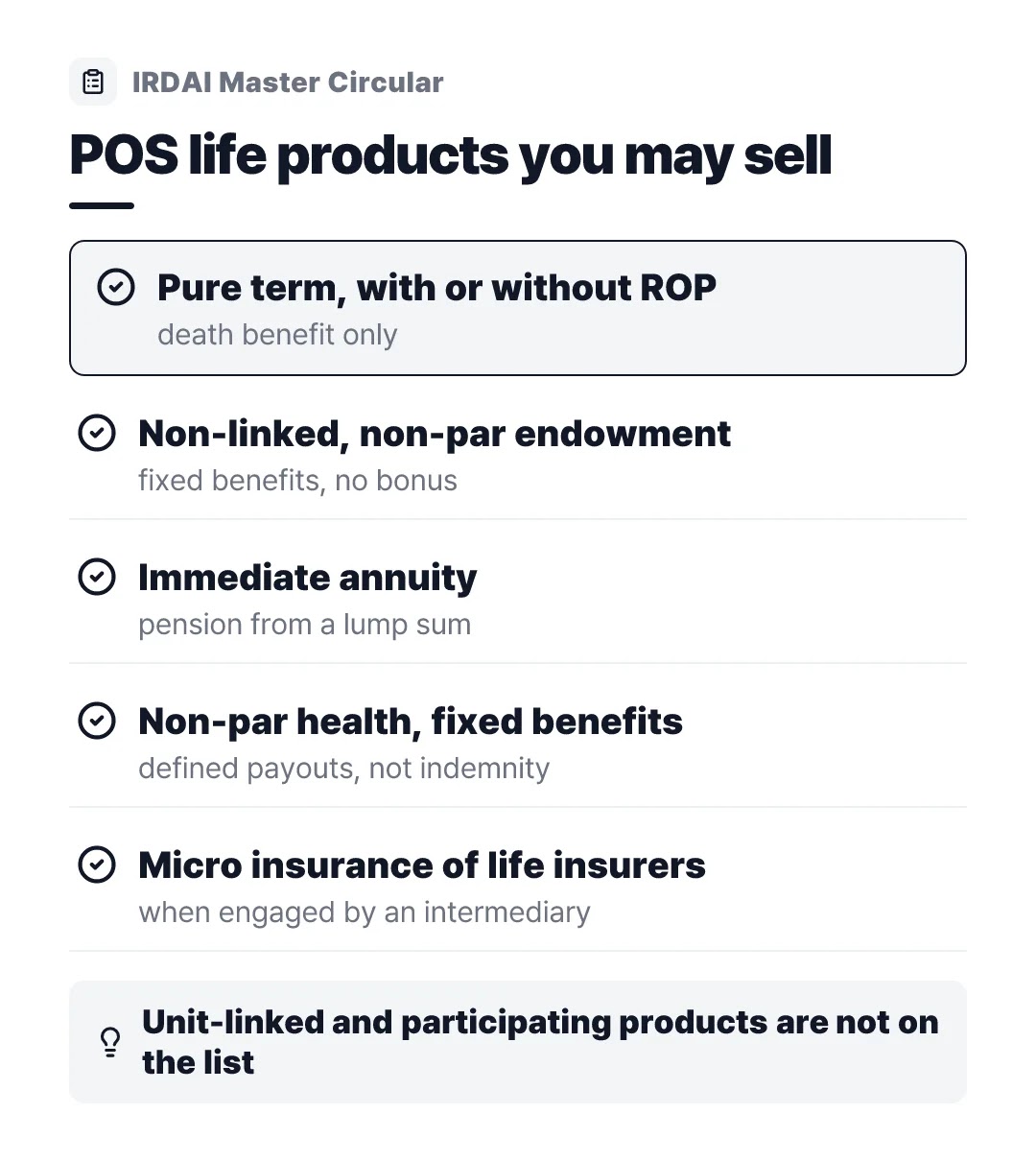
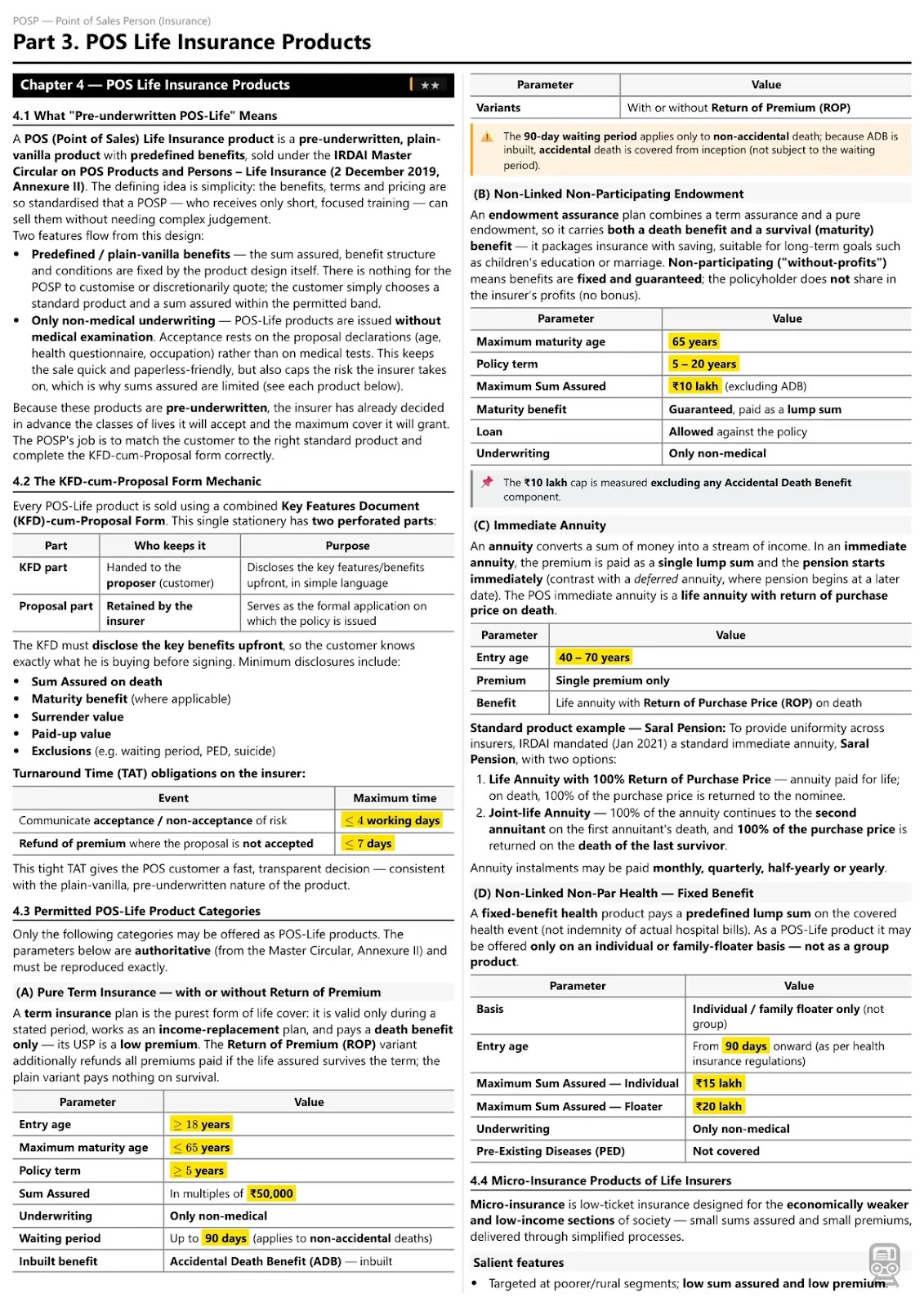
IRDAI's Master Circular on Point of Sales Products and Persons sets out the life products a Point of Sales Person may solicit, and the list is deliberately short. These are standard, largely pre-underwritten products — the kind an insurer's system can issue once a fixed set of details has been entered, with little judgement applied in between. The regulator's own reasoning runs the same way: simple products need basic training, so the channel exists to distribute them.
| Product category named in the circular | What it means in practice |
|---|---|
| Pure term insurance, with or without return of premium | Death benefit only, no investment component to explain |
| Non-linked, non-participating endowment | Fixed benefits, no bonus or fund performance to project |
| Immediate annuity | Pension paid from a lump sum, no accumulation phase |
| Non-linked, non-participating health with fixed benefits | Defined payouts rather than indemnity of actual expenses |
A POSP engaged by an insurance intermediary may also distribute micro insurance products of life insurers, and may sell the POS life products of every insurer that intermediary is authorised to represent. Read the table for what is absent as much as what is present. Unit-linked plans and participating policies do not appear anywhere on it, which means ULIPs, par endowments and anything requiring underwriting judgement sit outside this licence entirely.
Fifteen hours, and who signs off on them
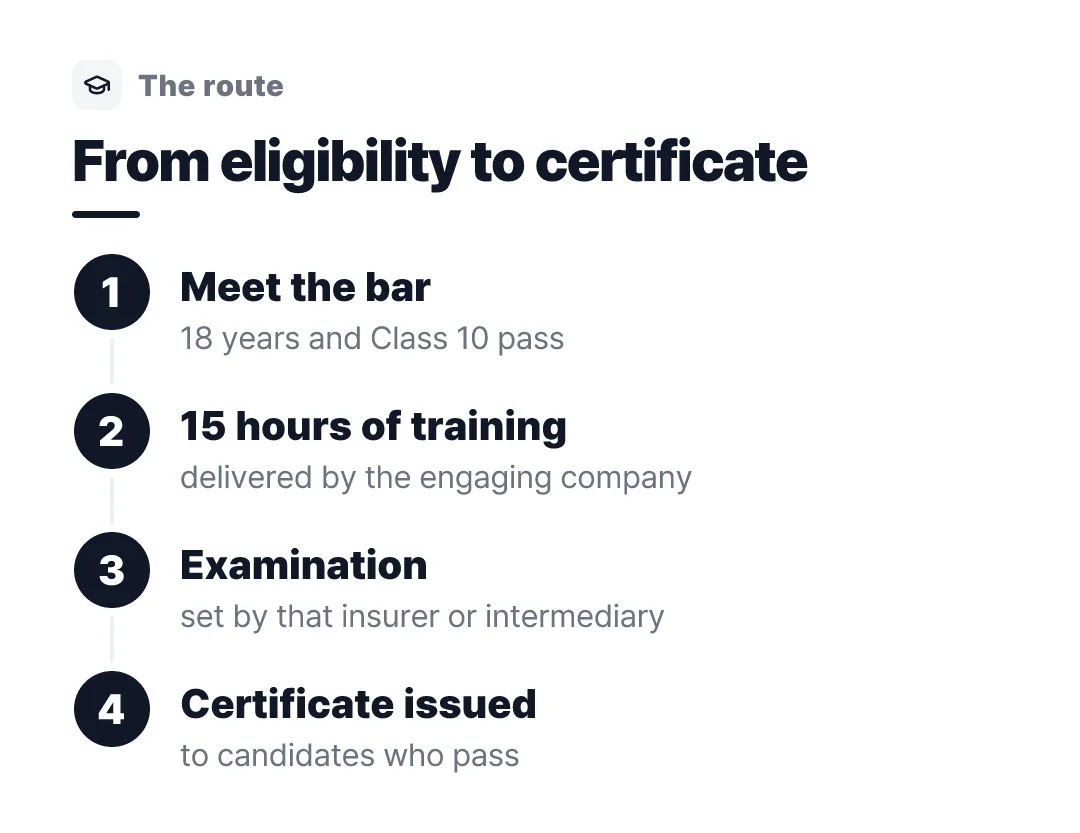
The eligibility bar is set in section 17.2 of the circular: at least eighteen years of age, and an educational qualification of Class 10 pass. There is no graduation requirement and no prior insurance experience, which is the point of the channel. Section 17.3 then places the training obligation on the insurer or intermediary that wants to engage you, not on an outside institute.
That same section fixes the training at fifteen hours, requires an examination after it, and requires a certificate to be issued to whoever passes. The examination is therefore run by the company sponsoring you, on the basis of the model syllabus the circular prescribes. Training partners commonly describe the paper as fifty marks of multiple choice with a forty per cent pass mark, but the circular does not fix the format, so treat those figures as the industry norm rather than as a regulatory minimum and confirm them with your sponsor.
One consequence is worth planning around. Because the certificate is issued by the engaging company, moving to a different insurer or intermediary is a question for your engagement terms rather than a portable licence you carry with you. The circular does not state a validity period, so the renewal cycle is something to settle before you sign, not after.
POSP or the IC-38 agent route
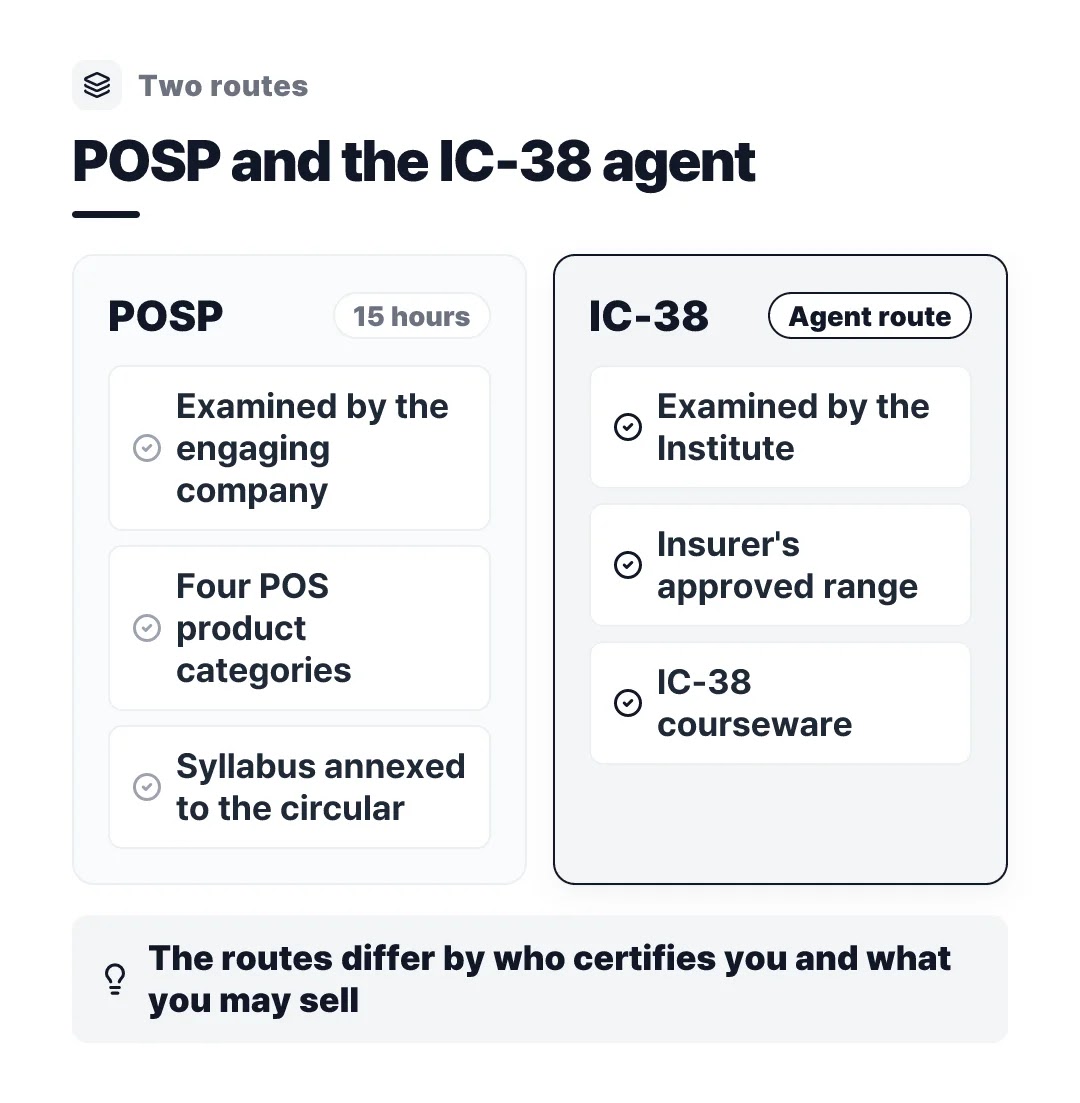
Candidates often compare the two routes on difficulty alone, which is the wrong axis. They differ in who certifies you and in what you may sell afterwards, and those two differences drive everything else.
| POSP (Life) | Agent, via IC-38 | |
|---|---|---|
| Who conducts the examination | The insurer or intermediary engaging you | Insurance Institute of India, on behalf of IRDAI |
| Training specified in the circular | Fifteen hours | Not covered by this circular |
| Products you may solicit | The four POS categories above, plus micro insurance | The insurer's approved range, subject to appointment |
| Where the syllabus comes from | The model syllabus annexed to the circular | The IC-38 courseware published by the Institute |
The practical reading is straightforward. If you intend to sell term cover, simple endowments, annuities and fixed-benefit health plans, the POSP route gets you there with a fifteen-hour course and a company-set test. If you expect to advise on unit-linked or participating products, the agent route is the one that carries those products, and no amount of POSP preparation substitutes for it.
The five modules the syllabus actually names
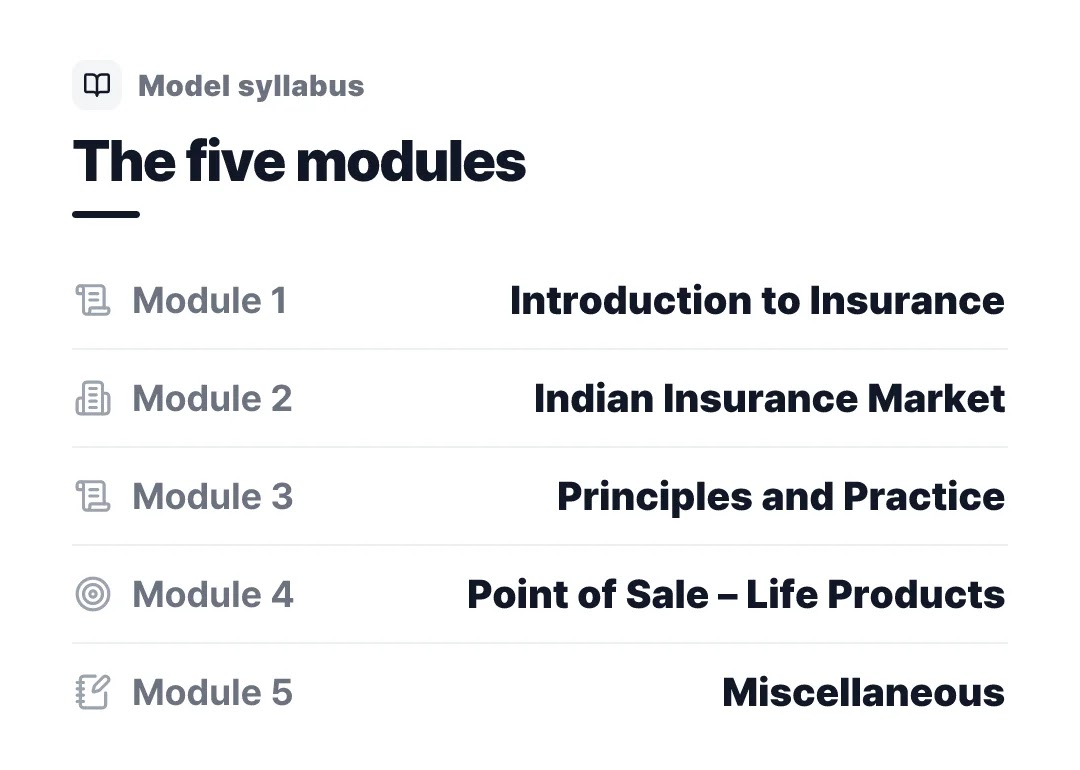
The model syllabus in the circular is organised into five modules, and they are not of equal use to you. Module 4, Point of Sale – Life Insurance Products, is the one that maps directly onto what you will be permitted to sell, so it deserves the first pass and the last revision. Modules 1 to 3 build the vocabulary — what insurance is, how the Indian market is structured, and the principles underlying a contract — and they tend to supply the definitional questions.
Work through them in the order the syllabus lists, but budget your hours against the four product categories rather than against page counts. A candidate who can explain the difference between a non-linked non-participating endowment and a participating one, in a sentence a customer understands, is prepared for both the paper and the first week of the job. Module 5 collects the remaining items and is worth a single careful read close to the test rather than early on.
How the 21 pages are arranged
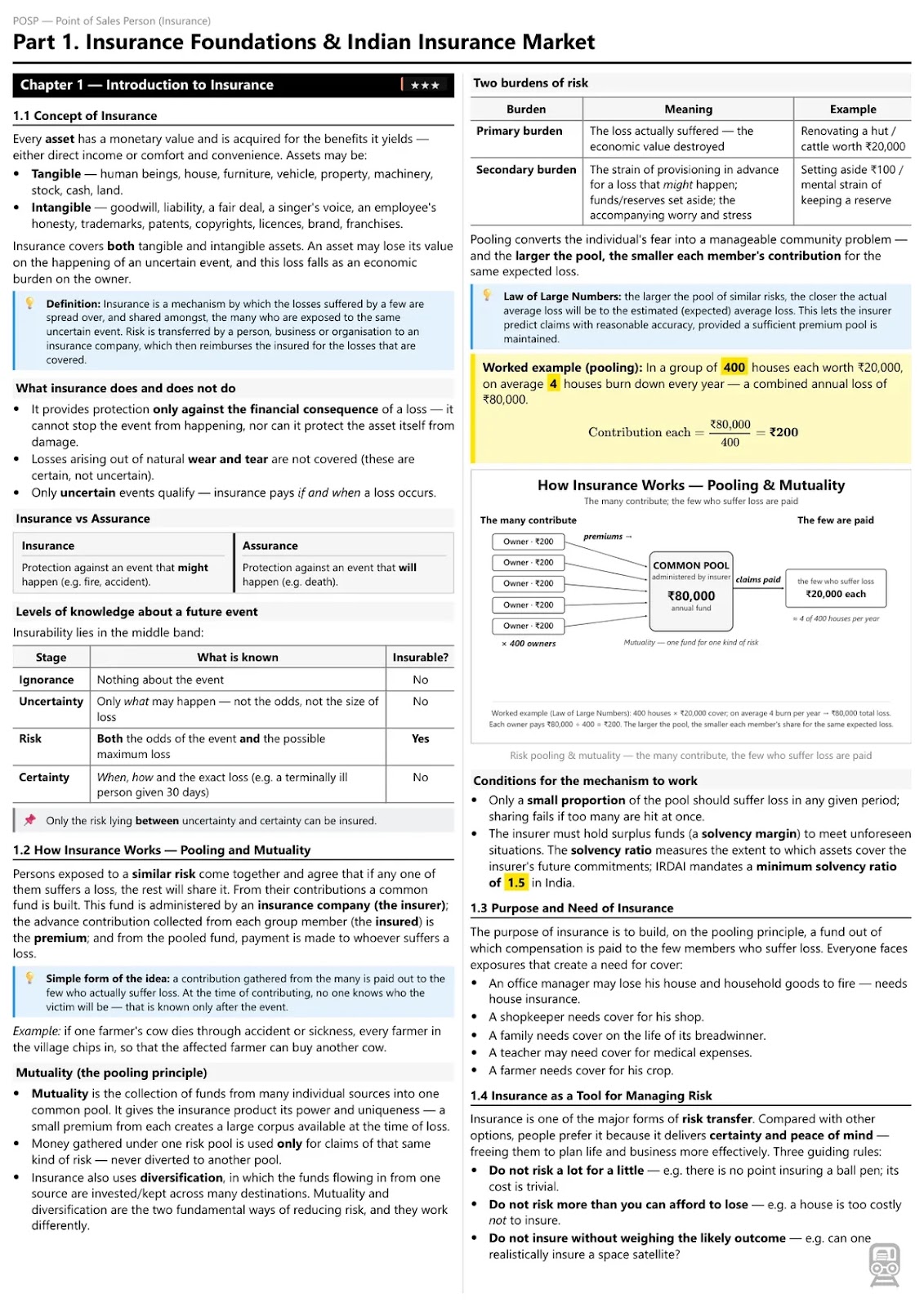
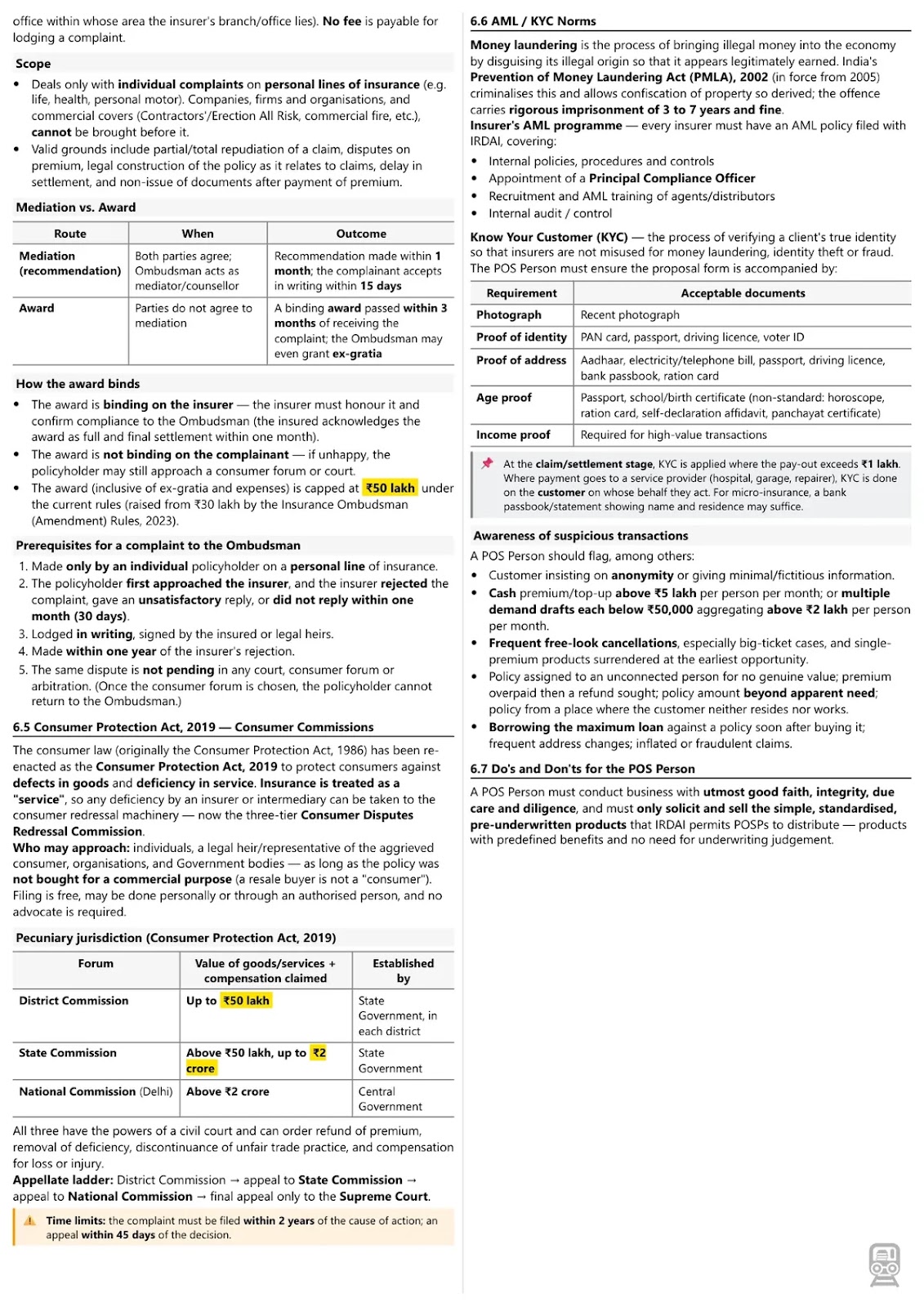
The POSP revision notes run to 21 pages and follow the circular's five modules, with the product module expanded because that is where the permitted categories are defined. The four POS product types are set out side by side, so the distinctions that are easy to blur on paper — non-linked against linked, participating against non-participating, fixed benefit against indemnity — are visible in one view. These are revision notes rather than a question bank: there are no mock papers or previous year questions inside, and they are meant for the pass you make after the training, not instead of it.
Priced at ₹ 299, the file downloads immediately after purchase.
👉 POSP revision notes — PDF (21 pages)
https://www.rattanote.com/library/posp-insurance-exam-notes
FAQ
What is the minimum qualification for a POSP?
Class 10 pass, with a minimum age of eighteen years, as stated in the Master Circular on Point of Sales Products and Persons. No degree and no prior insurance experience is required. The insurer or intermediary engaging you will verify these before the training begins.
Who conducts the POSP examination?
The insurer or insurance intermediary that engages you conducts it, after delivering the fifteen hours of training, and issues the certificate to candidates who pass. This is the main structural difference from IC-38, which the Insurance Institute of India conducts. The circular prescribes the model syllabus but leaves the paper's format to the company.
Can a POSP sell ULIPs?
No. The circular lists pure term, non-linked non-participating endowment, immediate annuity and non-linked non-participating health with fixed benefits, and unit-linked products do not appear on that list. Selling outside the permitted categories requires the agent or broker route instead.
The bottom line
A POSP certificate rests on fifteen hours of training, a Class 10 qualification and a test run by the company that engages you. The four permitted life product categories define the job more than the exam does, and unit-linked and participating products fall outside them. Decide which products you want to sell first, because that single choice settles whether this route or the IC-38 agent route is the right one.
If you are going ahead, ask your sponsoring insurer or intermediary for their training schedule and the syllabus version they examine on.
📄 21 pages, arranged around the four permitted product types
https://www.rattanote.com/library/posp-insurance-exam-notes
Rattanote is an independent publisher. These are unofficial revision notes and are not affiliated with, endorsed by or approved by IRDAI, the Insurance Institute of India or any insurer. Regulations, training requirements and examination rules change, so confirm the current position with IRDAI and with the insurer or intermediary engaging you before you apply.